
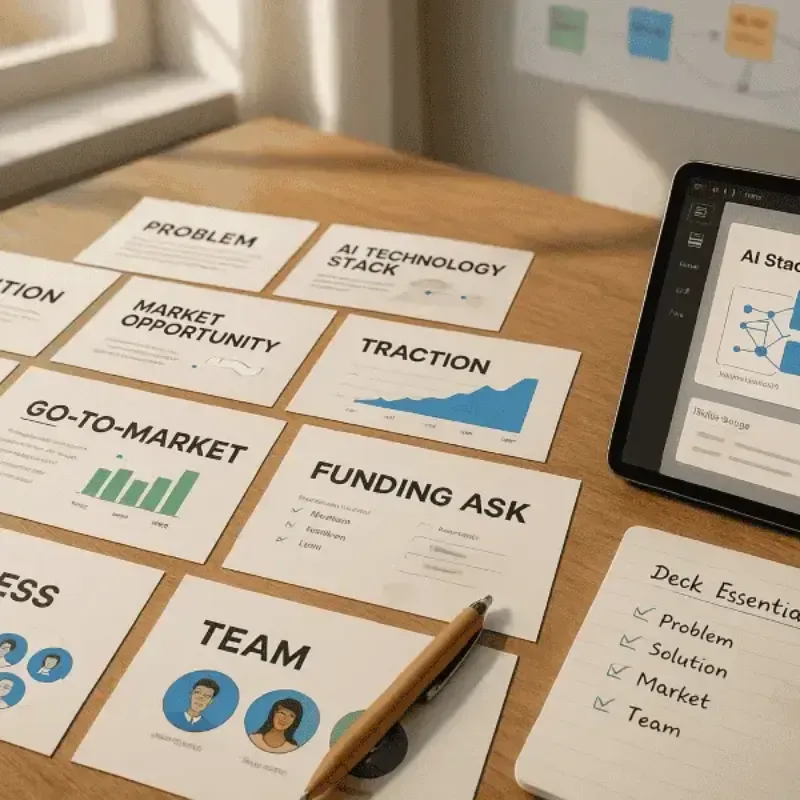
Pitching is storytelling. But great stories need structure, clarity, and emotional impact — especially when money, time, and growth hinge on a single deck. In recent years, AI has become a practical co-author for founders, helping craft cleaner narratives, stronger visuals, and data-driven slides. Tools — including the modern AI presentation maker — aren’t there to replace your voice; they’re there to amplify it, making every slide do more of the heavy lifting so you can focus on strategy, not pixel pushing.
Below I’ll walk you through how AI improves pitch decks, show practical ways to use it, highlight pitfalls to avoid, and provide a step-by-step workflow you can use today to produce a compelling investor deck.
Why storytelling matters (and where startups fail)
Investors don’t just buy metrics; they buy belief. A memorable deck communicates a clear problem, a differentiated solution, a believable market opportunity, and a credible team. Common mistakes include cluttered slides, mixed visual styles, inconsistent messaging, and data that’s hard to verify at a glance. Those flaws dilute the story and make decision-makers work too hard to understand the opportunity.
AI helps by streamlining the mechanics of presentation creation so your narrative remains front and center.
What AI brings to the storytelling table
1. Distilling complexity into clarity
AI can analyze long documents, product specs, or market research and extract concise, audience-ready summaries. That means you can turn a 30-page technical whitepaper into 2–3 crisp slides that explain the value proposition and defensible differentiation.
Actionable use: Paste your product brief into an AI summarizer and ask for a one-sentence problem statement, a two-sentence solution, and three bullets that prove traction or defensibility.
2. Designing with brand and pace in mind
Auto-layout and palette suggestions ensure visual consistency across your deck. AI can recommend font sizes, image placements, and white-space adjustments to improve readability — crucial when angel investors skim.
Actionable use: Use an AI tool’s template suggestions and then apply a single brand kit (colors, fonts, logo) across slides to maintain cohesion.
3. Turning data into compelling visuals
Raw KPIs are necessary, but not persuasive alone. AI can recommend the right chart type, surface trends, and annotate visuals with a one-line takeaway so viewers instantly grasp the point.
Actionable use: Upload your spreadsheet and ask the tool for a chart plus a headline like “Revenue up 3x in 12 months — CAC stable” rather than dumping a table of numbers.
4. Optimizing language and tone for your audience
Different investors respond to different framings — VCs vs. angels vs. strategic partners. AI can rewrite slide copy for tone (concise, confident, technical, or empathetic) and reduce jargon without losing nuance.
Actionable use: Create two versions of your executive summary — one tailored to product-focused investors and one for market-focused investors — and A/B test which opens better in outreach.
5. Rapid iteration and scenario testing
Want to see how your financials look with a different growth assumption? AI can regenerate projections based on alternative inputs and adjust the narrative to match (e.g., “With 20% higher conversion, our break-even arrives two quarters sooner”).
Actionable use: Keep a source spreadsheet and use AI to spin scenarios into one-slide “what-if” summaries for investor Q&A.
Practical workflow: Build a pitch deck with AI (step-by-step)
- Collect inputs — product one-pager, market research, traction metrics, team bios.
- Summarize core narrative — use AI to generate a short problem statement, unique solution, and one-line traction. Edit by hand to keep voice.
- Auto-generate slide skeleton — ask the tool to create slide titles and one-sentence notes for each slide (e.g., Problem, Solution, Market, Business Model, Traction, Team, Ask).
- Populate slides with visuals — upload data and let AI propose charts; add hero visuals suggested by the tool.
- Refine language — run each slide’s copy through tone-adjust prompts (shorter sentences, active voice, fewer buzzwords).
- Run a clarity pass — ask AI to identify the single sentence an investor should remember from each slide; if the sentence is weak, rewrite.
- Produce exportable formats — generate PDF + speaker notes; create a one-page appendix with backup metrics.
- Practice with simulated Q&A — use AI to generate likely investor questions and suggested concise answers.
This workflow balances automation with founder judgment: AI accelerates and augments, while you keep strategic control.
Pitfalls and ethical considerations
- Over-automation loses authenticity. Investors want founders’ voices; don’t replace your unique framing with generic prose. Use AI to refine, not to speak for you.
- Data provenance matters. If AI creates a chart from a merged dataset, double-check the numbers. Errors look worse in slides than in rough drafts.
- Design bias. Default templates can favor trendy aesthetics that clash with your brand. Customize to keep your identity intact.
- Privacy and IP. Avoid uploading sensitive customer data to public AI services without appropriate safeguards.
Actionable safeguard: Keep a simple checklist (verify key metrics, maintain founder tone, confirm visual accessibility) and run it before every investor send.
Measuring success: what to track
Track both process and outcome metrics: time to produce a first draft, number of iteration cycles, investor response rate, meeting conversion rate, and quality of feedback (do investors ask informed questions or basic clarification?). Use those signals to refine how you use AI — for example, invest more in data visualization if investors frequently ask for traction proof.
Closing thoughts
AI transforms pitch decks from static slide sets into adaptive storytelling tools. It speeds up iteration, polishes visuals, and helps translate complex business logic into investor-friendly language. But like any tool, its value depends on how thoughtfully you use it: combine AI’s speed with your founders’ conviction and market insight.
Start small: pick one area (copy, charts, or layout) and run a controlled test. You’ll quickly see where AI shaves hours off your workflow and where human judgment remains irreplaceable. With the right balance, AI will make your pitch not only cleaner and faster to produce — but also more persuasive when it matters most.

- TM SIM Registration 2026 - March 31, 2026
- .How to Choose the Best food warmer for Catering, Buffets, and Events - March 24, 2026
- How Cinema Culture Influences Modern Food Habits - March 14, 2026